Pilates basics
Breathing in Pilates: More Than Just Taking a Breath
iSPilates Studio5 min read
Breathing is one of the most natural things we do. But it takes on a whole new meaning once we start using it with intention.
We breathe thousands of times a day without giving it a second thought.
Breathing is automatic – nobody has to teach us how. What we do have to learn is how to coordinate it with movement.
In Pilates, the breath isn't just something that happens in the background. It's a key part of movement control, core stability and concentration.
Joseph Pilates placed great emphasis on conscious breathing in his original method, and modern Pilates has built on that idea with insights from anatomy and movement science.
What actually happens when you breathe in?
As you inhale, the diaphragm contracts and moves downward, the chest cavity expands, and the lungs fill with air.
When you're at rest, exhaling largely reverses this process on its own.
During movement, though, things get more complex.
The diaphragm, the abdominal wall, the pelvic floor and the stabilising muscles around the spine all work together to help regulate the stability of your torso.
That's why breathing can't be completely separated from posture or from the quality of your movement.
Pilates uses this connection deliberately.
What makes Pilates breathing different?
Modern Pilates often uses what's known as lateral breathing – breathing into the sides of the ribcage.
As you inhale, the aim is to feel your ribcage widen to the sides and into the back, while keeping control of your torso.
That doesn't mean breathing only into your chest, or that your abdominal wall must never move.
It's really about learning to notice and direct your breath in different positions and under different loads.
Linking breath and movement can help you find the rhythm, control and flow of each exercise.
The point isn't to take the biggest breath possible.
It's to let your breath support the movement.
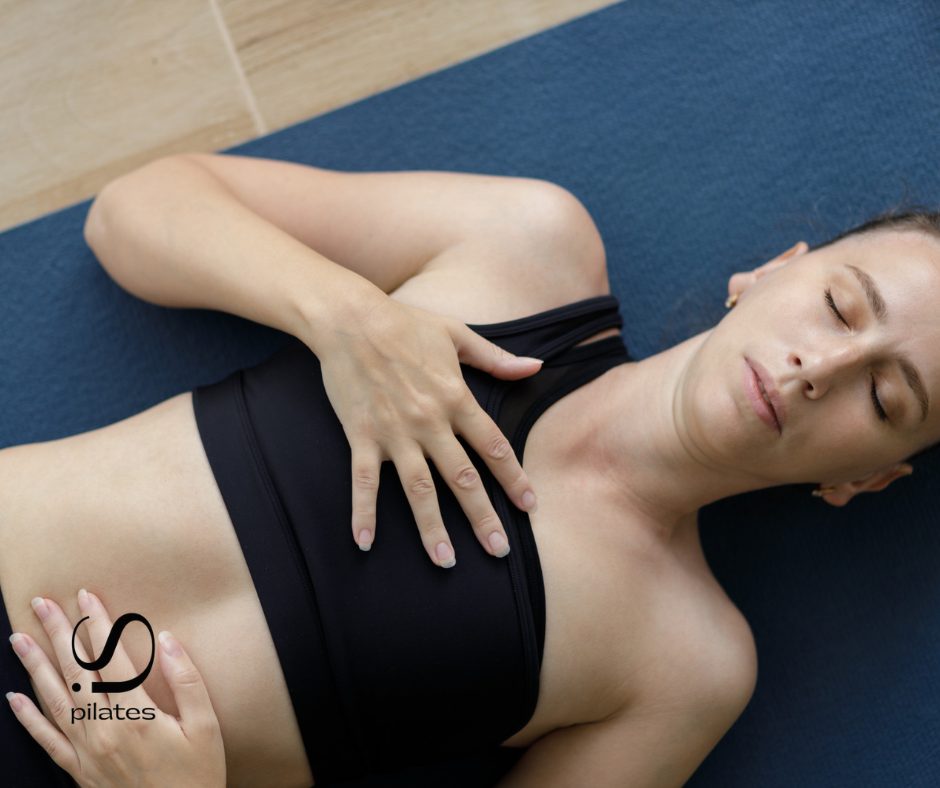
Inhale. Exhale. Move.
In a Pilates class, you'll often hear your instructor say:
“Inhale to prepare.”
“Exhale to move.”
These cues aren't random.
In many exercises, the exhale is paired with the part of the movement that demands the most effort or the most core control.
In other moments, the inhale can help open the chest, prepare for the movement or keep the rhythm of the exercise going.
That said, there's no single, universal breathing rule that applies to every Pilates exercise.
The timing of your breath can depend on the purpose of the movement, your position, the load and your own body.
Good breathing technique isn't a rigid rule.
It's a tool for moving mindfully.
Breathing and your core
When people hear the word “core”, most of them think of their abs.
In reality, the stability of your torso depends on several muscle groups working together.
And the diaphragm is part of that system too.
The link between breathing and core stability is especially interesting, because the same structures have to juggle partly different jobs.
They need to keep you breathing while also supporting controlled movement.
So in Pilates, we don't just strengthen the muscles of the torso.
We also learn how they work together across different movements and loads.
In a well-executed exercise, effort, stability and breath all support one another.
What happens when you hold your breath?
When we're concentrating hard or pushing through effort, many of us instinctively hold our breath.
It happens especially often when we're trying a new, more challenging movement.
Holding your breath can be a natural response in certain high-effort situations, but in most Pilates exercises the aim is to keep breathing in a controlled way throughout the movement.
If you keep holding your breath, it's easy to lose the rhythm of the exercise and build up unnecessary tension.
The goal isn't to breathe to a fixed count no matter what.
It's to stay in control of your breath, even while you're working hard.
Breathing helps you focus
One of the things that makes Pilates special is that it asks for your full attention.
It's not enough to simply repeat a movement. You need to sense where your body is, which direction you're moving in, how hard your muscles are working and how stable you are.
Conscious breathing gives all of this a rhythm.
It can help you stay focused, coordinate your movements and work through the exercises without rushing.
In some situations, slower and calmer breathing can also help ease tension.
But that doesn't mean every Pilates exercise has to feel relaxing.
Pilates can be dynamic, intense and genuinely physically demanding.
And in those moments, conscious breathing matters just as much.
Can you learn to breathe well?
Breathing comes naturally. Coordinating it consciously with movement, however, is a skill you can learn.
At first, you might be so focused on getting the exercise right that your breathing slips into the background.
Other times it's the other way round: you concentrate on your breath and lose the precision of the movement.
That's a completely normal part of learning.
With regular practice, bringing the two together gradually gets easier.
After a while, you no longer have to think through every inhale and exhale.
Your breath starts to connect with your movement more and more naturally.
Quality of movement is in the details
From the outside, a Pilates exercise often looks simple.
But the difference usually lies in details you can't see at first glance.
The position of your spine. Control of your pelvis. Stability in your shoulder blades. The direction of your effort.
And your breath.
Together, they shape how you perform every movement.
In Pilates, you don't just learn how to move. You learn how your whole body can work together in every movement.
Related class: Classes